






SCM Minimax ME 35ET Automatic Edgebander with Pre-Milling & Corner Radius - 1PH, 230V
- Price
- $ 33,775
Have questions or need help choosing a machine?
Call us at 260-637-0054 or email sales@oaktreesupply.com
Estimated to ship September 2026*
Factory install included in price
No hidden fees or surcharges.
Made in Italy. Ships from the United States.
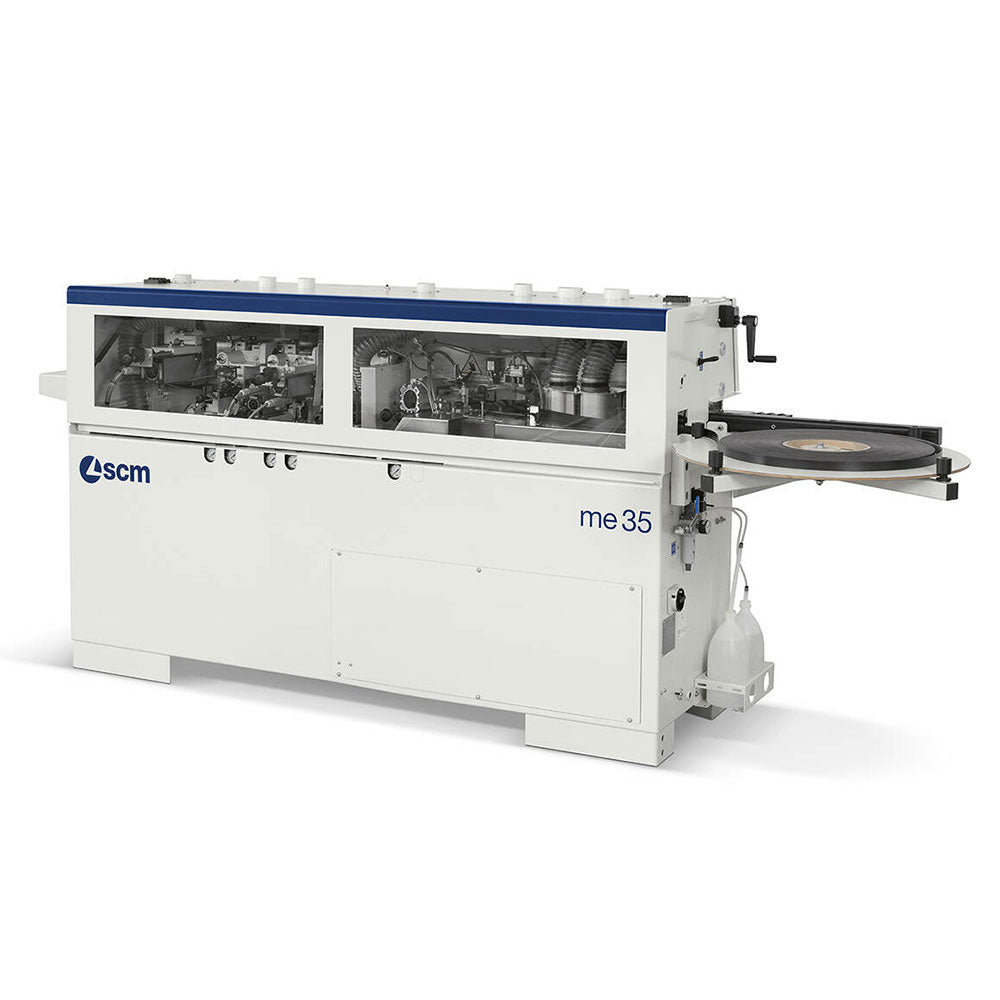
The ME 35ET moves onto SCM's Eye-S touchscreen platform and replaces the flat copying pads used on every machine below it with rotating copy discs on the trimming unit, opening up high-gloss and acrylic panel work those machines can't touch. It also adds a toggleable radius end cut and PUR glue compatibility, making it the first machine in the Minimax ME lineup built as much around finish quality and material range as raw throughput.
At a Glance:
- Designed for 3 to 4 hours/day operation, a step up in duty cycle from the ME 28ET's 2 to 3 hours
- Eye-S 10" touchscreen with Maestro active edge interface: 3D sequence preview, guided setup, and program memory for instant recall of saved edge specifications
- Dual diamond pre-mill standard: 3 kW at 7,200 RPM across two Ø80mm cutters, with the same four removal settings as the ME 28ET (0.5mm, 1mm, 1.5mm, 2mm)
- End cutting with built-in radius function standard: pneumatically activated from the Eye-S panel, toggleable on or off per batch
- Rotating copy discs on the trimming unit instead of flat pads: the first machine in the lineup rated for high-gloss and acrylic panel surfaces
- Glue pot rapid-swap kit standard with double thermoregulation: PUR-capable with the optional PUR glue pot
- Runs PVC and ABS rolled edges from 0.4mm to 3mm, strip edges (PVC, ABS, and solid wood) up to 5mm, and HPL (pre-mill disengaged for HPL runs)
- Minimum panel height drops to 8mm, down from 12mm on the ME 28ET
- 7 m/min (23 ft/min) feed speed; 3,000 x 525mm worktable
- Single-phase 230V, drawing 37A. Confirm with your electrician that your shop's service can support a dedicated circuit sized for this draw before ordering.
- Factory installation by an SCM-certified technician is mandatory for warranty coverage, included in the listed price
- Freight included; ships from U.S. warehouse
- Qualifies for Section 179 deduction
The Details:
A panel enters the pre-mill station first, ahead of every other process on this machine. Two diamond cutters, running at 3 kW and 7,200 RPM, trim a precise, selectable amount off the panel edge before it ever reaches the glue roller. A dedicated exhaust hood and air blower clear dust and chips from the edge before gluing, so the surface going into the glue station is clean and flat regardless of what the panel looked like coming off the saw or the CNC. Four removal settings are available: 0.5mm, 1mm, 1.5mm, or 2mm. Set the removal depth to match the thickness of the edge material you're applying, if you're running 1mm PVC, remove 1mm. That keeps the finished panel at exactly the size it was cut to, with no need to undersize the cut list to account for the banding.
Pre-milling earns its keep on problems that are otherwise invisible until the edge is already on. A scoring blade slightly out of alignment with the main blade on a panel saw leaves a small rabbet at the edge, which shows up as a visible gap or seam in the glue line once banding is applied. A dulling blade or router bit leaves chipping along the panel surface that's easy to miss until after the edge goes on and the defect is already sealed in. Panels cut to size and left sitting, over a weekend for instance, can pick up enough moisture to bulge slightly at the edge, which telegraphs through as a visible glue line once banded. And a saw blade that's out of square cuts a slight taper that concentrates glue and pressure unevenly along the edge, again invisible until banding reveals it. The pre-mill head corrects all of these before gluing rather than making you rework or scrap the panel after.
There are real tradeoffs to running a pre-mill unit, worth knowing going in. The added station means a longer machine, which means more floor space and more infeed/outfeed clearance to plan for. It also adds cost, both for the larger frame and for the pre-mill components themselves. The diamond cutters hold up well over time, though, and replacement cutters are inexpensive relative to the rest of the machine.
Maestro Active Edge Interface: Every machine below this one in the lineup runs a 4-line LCD panel with soft-touch buttons, reliable, but every parameter gets set by hand each session. The ME 35ET moves to a 10" Eye-S touchscreen running SCM's Maestro active edge software, and the jump is bigger than the screen size. Before a panel ever enters the machine, the Eye-S shows a 3D preview of the full processing sequence for the program you've set, so a conflicting or out-of-range setting shows up on screen instead of in a ruined panel. As you program a job, the active guidance system checks your settings against what the machine can actually do and flags problems before you run anything, a real difference from the LCD panel's manual, nothing-checks-your-work setup process. The radius end cutting function is activated and toggled on or off per batch right from the panel, no walking over to the unit itself required. And the Eye-S stores complete production setups for instant recall: a saved program for white PVC cabinet sides and a saved program for walnut veneer drawer fronts each load correctly the first time, with no re-calibration between jobs. For a shop running more than one edge spec regularly, that program memory is a genuine daily-workflow gain, not a checkbox feature. The Eye-S also supports an optional wireless barcode reader that recalls a stored program by scanning a work order, removing manual re-entry as a source of setup error.
Radius End Cutting: A standard 90-degree end cut trims the front and rear overhang of the applied banding flush with the panel, but leaves that trimmed edge sharp and square. The ME 35ET's end cutting unit, a Ø125mm, 12-tooth blade running at 12,000 RPM, rounds that edge over in the same pass instead of leaving it square. The function is activated pneumatically from the Eye-S panel and toggles on or off per batch, no tooling change required. It's a middle ground in the lineup: the ME 28ET's standard cut leaves that edge sharp with no option to change it, and the ME 35ETR's combined unit goes further, rounding all four corners of the panel in a single pass. The ME 35ET only rounds the leading and trailing ends of the banding itself, not the panel corners, and only on the batches where you turn it on.
Trimming Unit and High-Gloss Capability: This is the mechanical line that separates the ME 35ET from everything below it. The ME 20, ME 25E, and ME 28ET all use flat, stationary copying pads on the top/bottom trimming unit, sliding against the panel face to track the cutter. That sliding contact is fine on standard melamine and satin surfaces, but it can mar or haze high-gloss and acrylic panels. The ME 35ET replaces those pads with rotating copy discs, chrome-plated surfaces that roll against the panel rather than slide across it. Standard tooling profiles a 2mm radius along the top and bottom of the applied banding; 1mm, 1.5mm, and 3mm radius tooling sets are available separately for thinner or thicker edge profiles. The rolling contact from the copy discs is what makes high-gloss and acrylic work viable on this machine and not on the machines below it in the lineup.
Glue System and PUR Capability: The ME 35ET ships standard with a rapid-swap glue pot kit and a double thermoregulation system that supports two separate temperature profiles, EVA's standard 190°C (374°F) range and PUR's lower 100-120°C (212-248°F) range. Standard equipment includes an EVA pot. Running PUR requires the separate optional PUR pot, which carries an anti-adherent treatment the standard pot doesn't have; the two aren't interchangeable. The rapid-swap kit means a shop can keep both on hand, running EVA day to day and swapping in the PUR pot for kitchen, bath, or commercial work that calls for it. PUR requires its own daily discipline: it has to be purged from the pot with a flushing agent at the end of every session, or the unused glue cures permanently inside it and the pot has to be replaced.
Factory Installation: SCM requires factory installation and training by a certified technician for warranty coverage on the ME 35ET. The technician verifies alignment, makes necessary adjustments, and trains the operator on site. Installation does not cover running electrical service, floor or masonry work, or dust extraction lines; those need to be in place before the technician arrives. That installation is included in the price listed on this page, not billed as a separate line item.
Material Limits: The ME 35ET runs PVC and ABS in both rolled coil and strip form, solid wood strip edges up to 5mm, and HPL. Disengage the pre-mill unit when running HPL, the diamond cutter isn't recommended for that material, and HPL bonding requires a primer. The machine doesn't come standard with an automatic strip loading magazine, so strip material doesn't feed as hands-off as coil stock does; shops running strips regularly should look at the automatic strip loading device as a factory-order accessory.
Compressed Air: The ME 35ET requires a continuous supply at 6.5 bar (approximately 95 PSI). The built-in filter-regulator handles basic filtration, but moisture in the line is a known cause of pneumatic component failure. A refrigerated air dryer or quality desiccant filter upstream of the machine is strongly recommended. Confirm your compressor can maintain 6.5 bar continuously under load before the machine arrives.
Dust Extraction: The ME 35ET requires a minimum of 890 CFM, drawn across extraction points at the pre-mill, glue pot, and trimming stations. All connections should be made and maintained; the pre-mill extraction in particular is doing real work, pulling dust and chips off the edge before it reaches the glue station.
Electrical: The single-phase version draws 230V at 37A. That's a meaningful draw and needs its own dedicated circuit; confirm with your electrician that your shop's service can support it before scheduling delivery. If your shop already has 3-phase service, the 3-phase version of this machine draws roughly 30A at 220V and is worth a look.
Optional Accessories:
- 1mm and 1.5mm radius tooling sets: additional profile options beyond the 2mm radius tooling that ships standard
- 3mm radius tooling set: for larger rounded corner profiles, includes combo blade
- Spare glue pot, PUR: the component that gives this machine PUR capability, anti-adherent treatment required for PUR glue work, installs into the standard rapid-swap kit
- Spare glue pot, EVA fast-unload: quicker changeover for shops running multiple glue types or colors
- Internal LED lighting: straightforward add-on, meaningful visibility improvement for daily operation
- Glue scraping unit: removes excess glue squeeze-out at the panel/edge joint; technically field-installable but best set up by a certified technician, and it's manually adjusted rather than controlled from the Eye-S panel
- Panel edge heating device or infrared ceramic lamp: improves adhesion in cold shops, mounts before the glue station
- Wireless barcode reader: recalls stored Eye-S programs by scanning a work order, a strong add for shops running multiple edge specs
- Automatic strip loading device: factory-order accessory for shops running strip-form edge material regularly, cannot be added after purchase
Frequently Asked Questions
What's the difference between the ME 28ET and the ME 35ET?
More than a spec bump, it's a platform change. The ME 35ET moves to the Eye-S 10" touchscreen with program memory and guided setup, in place of the ME 28ET's 4-line LCD panel. It adds a toggleable radius end cut, which sits in between the two ends of the lineup: the ME 28ET's standard cut leaves the trimmed edge of the banding sharp and square, and the ME 35ETR's combined end cut/rounding unit goes further, rounding all four corners of the panel in a single pass. The ME 35ET's radius end cut only rounds the leading and trailing ends of the applied banding, not the panel corners, and only when it's switched on. It also replaces the flat copying pads on the trimming unit with rotating copy discs, which is what makes high-gloss and acrylic panel work possible, the ME 28ET can't run those surfaces at all. And it adds PUR glue capability with the optional PUR pot, which the ME 28ET doesn't support at any configuration. The pre-mill goes from a single cutter to two, and daily duty rating moves from 2 to 3 hours up to 3 to 4 hours. Those four changes, the control platform, the radius end cut, the copy discs, and PUR compatibility, are what separate the two machines. If none of them apply to your work, the ME 28ET remains the more economical choice.
What is the Eye-S control system, and what does Maestro actually add beyond a touchscreen?
The Eye-S is a 10-inch touchscreen running SCM's Maestro active edge software. The touchscreen itself is the least of it. Before a panel enters the machine, it shows a 3D preview of the full processing sequence for the program you've set, so a conflicting or out-of-range setting shows up on screen instead of in a ruined panel. As you program a job, the active guidance system checks your settings against what the machine can actually do and flags problems before you run anything, no equivalent exists on the 4-line LCD panel used on the ME 20 through ME 28ET, where every parameter is set manually with nothing checking your work. The radius end cutting function is activated and toggled per batch directly from the panel. And it stores complete production setups for instant recall, so a saved program for one edge spec and a saved program for another each load correctly the first time, with no re-calibration between jobs. An optional wireless barcode reader recalls a stored program by scanning a work order, which removes manual re-entry as a source of setup error.
Can the ME 35ET run high-gloss or acrylic panels?
Yes. The trimming unit uses rotating copy discs, chrome-plated surfaces that roll against the panel rather than sliding across it the way flat copying pads do on the ME 20 through ME 28ET. That rolling contact is what prevents marring and hazing on high-gloss and acrylic surfaces.
How does the radius end cutting function work?
A standard 90-degree end cut trims the front and rear overhang of the applied banding flush with the panel but leaves that trimmed edge sharp and square. The ME 35ET's end cutting unit, a Ø125mm, 12-tooth blade running at 12,000 RPM, rounds that edge over in the same pass instead of leaving it square. It's activated pneumatically from the Eye-S panel and can be toggled on or off per batch, no tooling change required. It's a middle ground in the lineup: the ME 28ET's standard cut leaves that edge sharp with no way to change it, while the ME 35ETR's combined unit goes further and rounds all four corners of the panel in one pass. The ME 35ET only rounds the leading and trailing ends of the banding, not the panel corners, and only when you choose to turn it on.
Does the ME 35ET support PUR glue?
With the optional PUR glue pot, yes. Standard equipment includes an EVA pot; running PUR requires the separate PUR pot, which carries an anti-adherent treatment the standard pot doesn't have, so the two aren't interchangeable. The rapid-swap kit means a shop can keep both on hand and switch between them as jobs call for it, EVA day to day and PUR for kitchen, bath, or commercial work that needs it. PUR has its own daily requirement: it has to be purged from the pot with a flushing agent at the end of every session, or the unused glue cures permanently inside it and the pot needs to be replaced.
Can the ME 35ET run HPL edges?
Yes, with the pre-mill unit disengaged. The diamond pre-mill cutters aren't recommended for HPL material, and HPL bonding also requires a primer. With the pre-mill off, the rest of the sequence, gluing, radius end cutting, trimming, scraping, and buffing, runs the same as it does on PVC or ABS.
Can the ME 35ET apply solid wood edge strips?
Yes, up to 5mm. The machine doesn't come standard with an automatic strip loading magazine, so strip material doesn't feed as hands-off as coil stock; shops running strips regularly should look at the automatic strip loading device as a factory-order accessory.
Do I need three-phase power for the ME 35ET?
No. This version runs on single-phase 230V at 37A. Confirm with your electrician that your shop's service can support a dedicated circuit sized for that draw before the machine is scheduled for delivery. A 3-phase version is also available and draws roughly 30A at 220V if your shop already has 3-phase service.
How many hours a day can I run the ME 35ET?
It's rated for 3 to 4 hours of actual operation per day, a step up from the 2 to 3 hour rating on the ME 20, ME 25E, and ME 28ET.
Why does this machine require factory installation?
SCM mandates it for warranty coverage on this machine, the same as it does on the ME 28ET. A certified technician verifies alignment, makes adjustments, and trains the operator on site, and that installation is included in the price listed on this page, not billed as an add-on. It doesn't cover running electrical service, floor or masonry work, or dust extraction lines; those need to be in place before the technician arrives.
What daily and weekly maintenance does the ME 35ET need?
Daily: blow out the inside of the machine with compressed air at the end of every shift. Chip buildup on the copying discs at the trimming and scraping units is the leading cause of poor edge quality and the majority of service calls on this machine, it takes five minutes and prevents most problems. Also daily: drain the water separator on the compressed air line, and scrape the glue pot walls with a wooden stick, never metal, to remove carbonized buildup. Weekly: vacuum dust and shavings from both pre-mill cutters and clean the brushes with a suitably shaped vacuum attachment, and check the drive belt for tension and wear.
What if I need to compare the ME 35ET to other machines in the ME series?
View the ME Edgebander Comparison Chart to see how the ME 35ET stacks up against the ME 20, ME 25E, ME 28ET, ME 35ETR, ME 40ETR, and ME 40EVO by processing unit, daily duty rating, and electrical configuration.
Is the ME 35ET eligible for a Section 179 tax deduction?
Yes. The Minimax ME 35ET qualifies as a capital equipment purchase under Section 179, which allows businesses to deduct the full purchase price of qualifying equipment in the year it is placed in service rather than depreciating it over several years. For a machine at this price point, that deduction can meaningfully offset the net cost of purchase. The deduction limit and phase-out thresholds adjust annually, so the exact benefit depends on your total equipment purchases for the year and your tax situation. Consult your tax advisor on how Section 179 applies to your business. See how much you could save with our Section 179 calculator.
Features
- Eye-S 10" touchscreen with Maestro active edge software: 3D sequence preview, active guidance that checks settings before you run them, and program memory for instant recall of saved edge specifications
- Dual diamond pre-mill unit: 3 kW at 7,200 RPM across two Ø80mm H=56 Z2 cutters, in four removal settings (0.5mm, 1mm, 1.5mm, 2mm)
- Radius end cutting unit: Ø125mm Z12 blade at 12,000 RPM rounds the trimmed front and rear ends of the applied banding instead of leaving them sharp and square; pneumatically toggled on or off per batch from the Eye-S panel
- Rotating copy discs on the T/B trimming unit: chrome-plated discs make rolling contact with the panel surface instead of sliding contact, the difference that enables high-gloss and acrylic panel work
- Glue pot rapid-swap kit: tool-free pot changeover with double thermoregulation, supporting separate EVA and PUR temperature profiles; PUR-capable with the optional PUR glue pot
- Self-lubricating glue pot: reduces routine maintenance on the glue system
- Encoder on the panel feed track pinion: precise panel position tracking through every station
- SCM-exclusive panel conveying track: consistent, controlled panel travel through all processing stations
- High-rigidity ribbed steel machine frame: dimensional stability and vibration resistance built into the base structure
- Automatic edge loading system: feeds rolled coil stock with built-in shear device
- Profile scraping unit: removes the witness line at the edge-to-panel joint along with machining marks left by the top/bottom trimmers
- Buffing unit: two motorized, tilted, vertically adjustable brushes clean and polish the finished edge
- Coil holder plate: 730mm diameter; accepts standard edge coil stock
- Safety enclosure: lockable main power switch, dedicated emergency pushbutton
Specs
Worktable dimensions: 118.06" x 20.62" (3,000 x 525mm)
Worktable height: 35.56" (904mm)
Edge thickness, rolled coil (PVC/ABS): 0.016" to 0.118" (0.4 to 3mm)
Edge thickness, strip (PVC/ABS/solid wood): Up to 0.197" (Up to 5mm)
Min./max. panel height: 0.31" to 1.97" (8 to 50mm)
Min. panel length / width: 7.5" x 4.31" (190 x 110mm)
Feed speed: 23 ft/min (7 m/min)
Pre-mill motor: 3 kW - 7,200 RPM | two cutters Ø80mm H=56 Z2 (diamond)
Pre-mill removal settings: 0.5mm / 1mm / 1.5mm / 2mm
Radius end cutting blade: Ø125mm Z12 - 12,000 RPM
T/B trimming motors: 2 x 0.35 kW - 12,000 RPM | cutters Ø55.3mm Z3
Glue pot capacity: ~2 lbs (0.8 kg)
Dust extraction: 890 CFM min
Pneumatic supply: 6.5 bar (95 PSI) required
Electrical: 230V - 60Hz - Single phase - 37A
Includes
- 2mm radius tooling set
- Standard toolkit for routine adjustment and maintenance
- Operator manual
- Factory installation and training, mandatory for warranty coverage, included in the listed price
Warranty
SCM warrants every machine free of defects in workmanship and materials for one (1) year from the date of customer acceptance. Belts, bearings, and common electrical parts carry a six-month warranty. Wearable items and components requiring maintenance in ordinary operation are excluded. Warranty coverage on the ME 35ET is contingent on factory installation by an SCM-certified technician, included in the price above.
Shipping
Please note: Items being shipped to extremely remote areas or areas with limited delivery access (such as islands only accessible by ferry) may incur additional shipping or freight fees. If your order requires any additional fees other than what is already included in the price, you will be contacted before those fees are applied and before your item ships. This is rare and will not apply to most orders.
*Machinery Availability Key
Availability statuses found above the product description reflect where a machine is in the supply chain at the time of listing. Use the key below to help determine the lead time for this machine.
In stock for immediate shipment: The machine is in OakTree Supply's warehouse and is ready to ship.
In stock as of [date] / Low stock as of [date]: The machine is in the manufacturer's U.S. warehouse and was available as of the last update we received. Estimated to ship in 3-5 business days. If low stock, please call us before ordering to confirm current availability.
Estimated to ship [date]: The machine is not yet in our warehouse or the manufacturer's warehouse. The date shown is an estimate based on current production and shipping timelines and may change due to manufacturing schedules, import processing, or freight transit.
Dates listed as "estimated" are not guaranteed and may change. OakTree Supply is not responsible for delays in transit to or from our facility.