






SCM Nova S 520 - Xylent 20" Planer with Segmented Infeed Roller
- Sale price
- $ 15,575
- List price
- $ 17,075
Have questions or need help choosing a machine?
Call us at 260-637-0054 or email sales@oaktreesupply.com
In stock for immediate shipment!*
No hidden fees or surcharges.
Made in Italy. Ships from the United States.
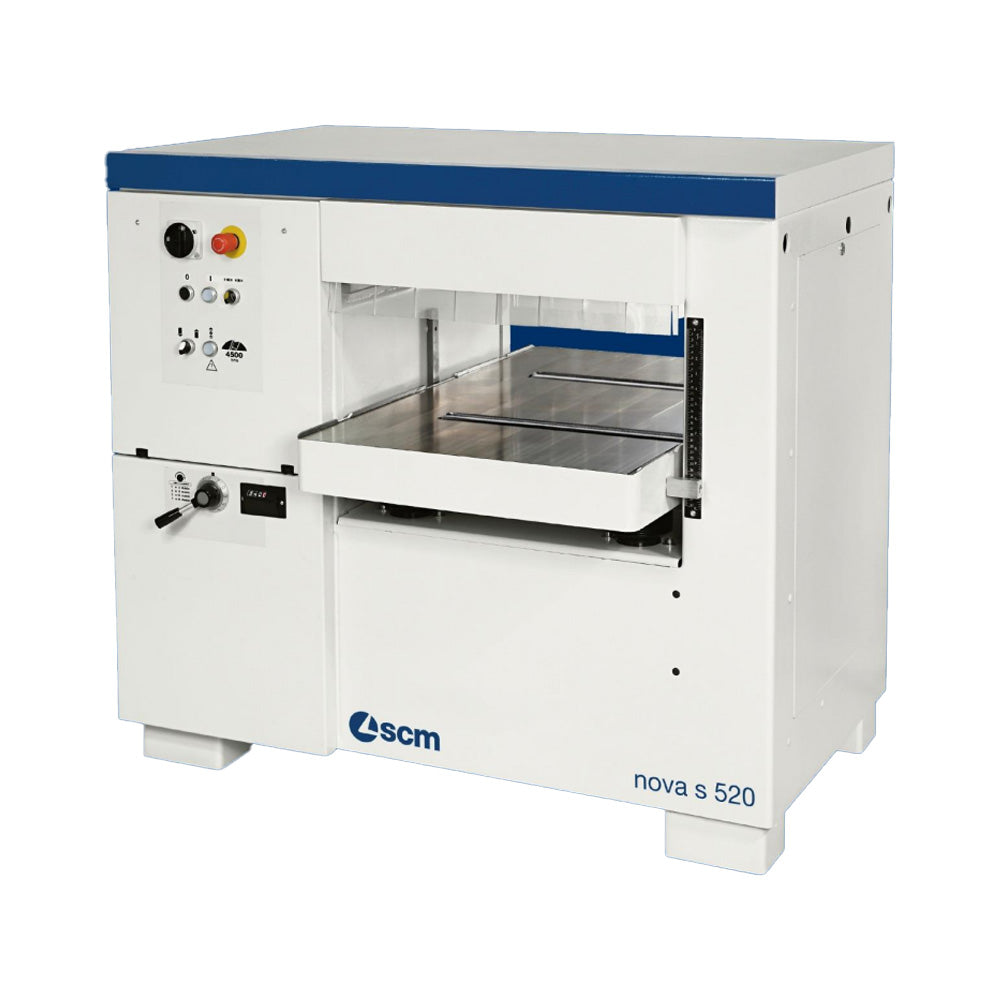
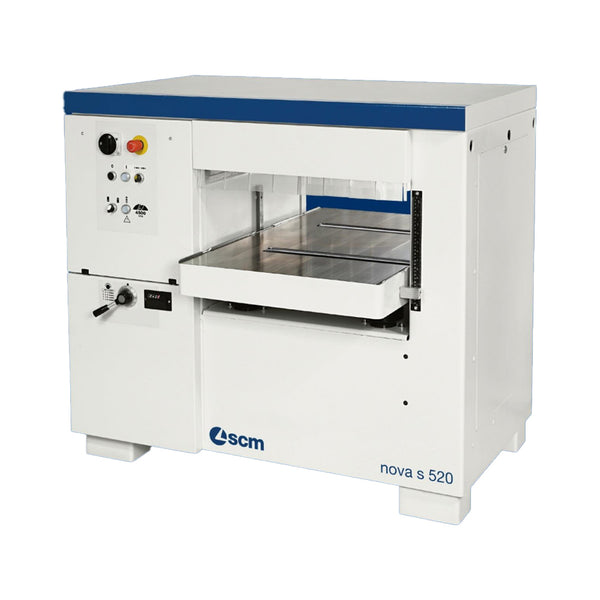
The SCM Nova S 520 X is a 20" industrial planer built in Italy — 11 HP 3-phase motor, monoblock welded base, powered table lift with digital readout, and an SCM Xylent cutterhead with 84 carbide inserts. This configuration replaces the standard helicoidal steel infeed roller with a segmented infeed roller, making it the right machine for shops running multiple boards side by side or processing stock with significant surface variation. SCM builds this variant to order with a typical 4-6 month lead time. OakTree currently has units in stock and ready to ship.
Requires 3-phase power (220V, 25A circuit). Confirm service availability before ordering.
At a Glance
- Segmented infeed roller: Independent roller sections across the full working width. Each section adjusts to its own board surface independently — multiple boards of varying thickness feed side by side without one affecting the other. Also conforms to significant surface variation across a single board.
- Factory-configured variant, in stock now: This configuration carries a typical 4-6 month lead time when ordered from the factory. OakTree has units available and ready to ship.
- 20.5" (520mm) working width: Handles lumber and edge-glued panels up to 20.5".
- 11 HP, 3-phase, 220V: Purpose-built production motor. 25A circuit required.
- SCM Xylent cutterhead — 84 carbide inserts across the full 20.5" working width: 15×15×2.5mm carbide, four cutting edges per insert. Spiral geometry reduces noise and produces fine chips. Carbide holds its edge significantly longer than HSS on abrasive and resinous species.
- Powered table lift with digital readout: 2-speed powered bed movement with micrometric fine adjustment. Set thickness precisely and use the readout as a reliable reference when returning to a previously used dimension.
- Monoblock welded base, heat-treated: Single normalized steel structure — all machine components mount and reference to one frame. The structural reason original S 520s from the 1990s are still holding tolerance in working shops today.
- 4 Acme-thread jack screws: Acme threads distribute load across a wider contact face than standard V-threads, resisting wear and table deflection under sustained load.
- 4 fixed feed speeds — 16, 26, 39, 59 FPM: Two speeds for rough stock removal; two for finish passes on demanding grain.
- Adjustable idle bed rollers: Raise for rough, heavy, or wet lumber to reduce feed resistance on initial passes. Lower flush with the table for finish passes where surface quality is the priority.
- 6" (150mm) dust port, 754 CFM minimum.
- Freight included; ships from U.S. warehouse
The Details
A planer's job is to thickness lumber and edge-glued panels to a consistent, accurate dimension — without snipe, without compression marks, and without variation across the width of the board. The Nova S 520 X is built around structural decisions that directly address those outcomes. This configuration adds one more: a segmented infeed roller that handles stock conditions the standard roller cannot.
Segmented Infeed Roller: The standard Nova S 520 X ships with a helicoidal steel infeed roller — a single roller spanning the full working width. That roller works well for most planing work. Where it has a limitation is batch processing: when you feed two or more boards side by side and those boards are not exactly the same thickness, the solid roller lifts to accommodate the thickest board and loses consistent downward pressure on the thinner ones. A thinner board next to a thicker one can slip, chatter, or feed unevenly through the pass.
The segmented roller solves this directly. Rather than one solid roller spanning the full width, it is built from numerous small segments mounted on a shared drive shaft, each independently tensioned by its own spring. When one segment rides up over a thicker board, its spring compresses independently — the segments beside it stay pressed down against whatever surface is beneath them. Every board in the pass gets consistent feed pressure regardless of what is happening across the width. The same principle applies to a single board with significant surface variation: the segments conform to the surface rather than bridging over low spots the way a solid roller does. The SCM Class S 630 ships with this roller as standard equipment — on the S 520, it is a factory-configured variant. This is the configuration for shops that batch-process multiple pieces in a single pass, work regularly with highly variable rough stock, or run enough volume that the efficiency of parallel feeding is a genuine daily advantage.
Monoblock Base: The SCM Nova S 520 is manufactured in Italy, and the monoblock base is central to how SCM builds this machine to last. It is a single welded steel structure that undergoes normalization — a heat treatment process that relieves internal stress and stabilizes the metal. Every mechanism on the machine mounts and references to this single structure. With a machine built on a bolted or multi-piece frame, each component references to a different casting or weldment. Those joints shift under sustained load and vibration over time. With a monoblock base, there is no joint to shift. It is why S 520s built in the 1990s are still holding tolerance in working shops today.
Acme-Thread Jack Screws: The table rides on four Acme-threaded jack screws. Acme threads have a trapezoidal profile that distributes load across a wider contact face than the V-shaped profile of standard threads. Under continuous heavy use, this geometry wears more evenly and maintains table stability longer. SCM's design also prevents chain drive pressure from transferring directly to the jack screw shaft — eliminating a secondary source of table movement that contributes to snipe over the machine's life.
Connecting Rod Roller System: Both the infeed and outfeed roller assemblies are mounted at the end of pivoting arms rather than on fixed axles. On a conventional planer, the infeed roller sits on a fixed shaft pressed downward by spring tension. As the board's leading edge pushes under it, the roller lifts straight up against that resistance — pressure is momentarily uneven and the board can hesitate or receive a compression mark from the infeed roller at entry. On the Nova S 520, each roller assembly swings up along the arc of the connecting rod's pivot point rather than pushing straight up against fixed resistance. Pressure stays consistent through the full entry and exit — the board feeds through without hesitation and the roller leaves no entry or exit marks on the surface. The segmented infeed roller on this configuration works within the same connecting rod assembly, with each individual segment additionally tensioned by its own spring to independently conform to the surface beneath it.
Idle Bed Rollers: Two adjustable idle rollers are set into the cast iron table and controlled by a lever on the infeed side of the bed. When raised slightly above the table surface, they allow rough, heavy, or wet lumber to feed through on initial passes without fighting resistance across the full table length. For finish passes, lower them flush with the table — the board then rides the full cast iron surface, which is the more stable reference for final thickness and surface quality. If you are getting snipe on finish passes, lowering the bed rollers is the first adjustment to make.
Xylent Cutterhead: 84 carbide inserts across a 520mm spindle (120mm diameter) in three spiral rows. Each 15×15×2.5mm insert has four usable cutting edges — rotate 90 degrees when an edge dulls, replace after the fourth edge. Insert seat cleaning is not optional: each seat must be cleaned individually before rotating. Skipping this step produces lines in the planed surface. A standard solvent and a stiff bristle brush are the right tools for this job.
Feed Speeds: The four fixed speeds reflect how thicknessing work actually gets done. Rough stock comes off the saw with surface variability — in the early passes you are removing material unevenly. Running at 39 or 59 FPM through those passes is efficient. Once the board is consistent and you are working toward final dimension, 16 or 26 FPM gives a cleaner surface with less tearout on difficult grain. Match the speed to the stage of the work.
Powered Table Lift: Two-speed powered bed movement — fast for coarse positioning, slow for the micrometric fine adjustment needed to dial in a precise final thickness. The digital readout gives you a reliable reference to return to when running repeat dimensions. You set the dimension and note the readout; returning to it requires dialing back to that number manually.
Dust Extraction: 6" (150mm) port. Minimum 754 CFM required. This machine produces shavings at volume — make sure your collection system is genuinely up to the task before the machine arrives.
Do You Have a Jointer? A planer requires a flat reference face to work against. Without one, the planer reproduces any bow or twist in the lumber at consistent thickness rather than correcting it. If you do not have a jointer, the SCM Nova F 410, Nova F 520, and L'Invincibile F 7 are the appropriate machines to pair with this one.
Frequently Asked Questions
What is the segmented infeed roller and why does it matter?
The standard Nova S 520 X uses a single helicoidal steel infeed roller spanning the full working width. The segmented roller replaces that with numerous small segments on a shared drive shaft, each tensioned by its own spring. When one segment rides up over a thicker board, its spring compresses independently — the segments beside it stay pressed down against whatever surface is beneath them. Every board in the pass gets consistent feed pressure regardless of thickness variation between them. The same principle applies to a single board with significant surface variation across its face: the segments conform to the surface rather than bridging over low spots. If your operation involves batch processing multiple pieces in a single pass or regularly working with highly variable rough stock, the segmented roller is a meaningful operational advantage.
Why is this configuration hard to find?
SCM builds the segmented infeed roller configuration to order. Lead time from the factory is typically 4-6 months. OakTree purchased units that SCM had in stock in North America — these are available now and ready to ship. Once sold, availability will depend on lead time from a new factory order.
Does this machine require 3-phase power?
Yes. The Nova S 520 X is a 3-phase only machine — 220V, 11 HP, 25A circuit. There are no single-phase variants in the Nova standalone planer lineup. Confirm 3-phase service availability, your panel's available amperage, and that you can run a 25A circuit to the machine's location before ordering.
SCM Nova S 520 Xylent vs Tersa: which cutterhead should I choose?
Tersa for cut quality. Xylent for production volume and lower maintenance frequency. Per SCM's own specs, the Xylent head runs 4dB quieter than Tersa — a difference most operators consider marginal. Where Xylent earns its place is in shops processing meaningful volume, particularly on abrasive or resinous species where carbide insert life significantly outlasts HSS knives. The finer chip output also keeps dust collection running more efficiently over long sessions. For a shop where the best possible surface off the machine is the priority and volume is moderate, Tersa is the stronger choice.
What causes snipe, and how does this machine address it?
Snipe — the slight over-cut at the leading and trailing ends of a board — is primarily a function of table stability and roller behavior as the board enters and exits the cutterhead. The Nova S 520 addresses both: Acme-thread jack screws resist table movement under sustained load better than standard threads, and the connecting rod roller system keeps feed pressure consistent through the full entry and exit rather than momentarily uneven as the roller lifts. With proper setup, snipe on this machine is minimal. Lower the bed rollers flush with the table for finish passes.
What dust collection do I need?
754 CFM minimum through a 6" (150mm) port. This machine produces shavings quickly — verify your collector's rated output and that your ductwork is sized for a 6" connection before delivery.
Do I need a jointer to use this machine?
Yes, in practical terms. A planer references off the bottom face of the board. If that face has any bow or twist, the planer reproduces that geometry at consistent thickness — it does not correct it. A jointer establishes the flat reference face the planer works against. Without one, you cannot produce truly flat, dimensioned stock from rough lumber. The SCM Nova F 410, Nova F 520, and L'Invincibile F 7 are the appropriate jointers to pair with this machine.
SCM Nova S 520 vs SCMI S 520: what changed?
The Nova S 520 descends from the same design platform. The Nova version adds powered table lift, digital readout, and updated electronics that the older machines lacked. The community regards both generations highly — the pre-Nova machines are regularly cited on forums as machines people have run flawlessly for 20-plus years. The Nova adds meaningful daily-use convenience. The core structural advantages — monoblock base, Acme-thread jack screws, connecting rod roller system — carry forward from the original design.
What is the minimum stock size?
Minimum thickness is 0.12" (3.5mm). Minimum length is 8.7". Maximum working thickness is 11.75" (300mm).
Is shipping included?
Yes, shipping is included.
Is business financing available?
Yes. OakTree has partnered with First Citizens Equipment Finance to offer business financing on qualifying purchases. Financing is available to established businesses and can be applied for directly from any qualifying product page — look for the monthly payment estimate below the Add to Cart button and click through to submit a pre-approval application. If approved, a First Citizens representative will follow up to discuss payment terms.
Is this eligible for a Section 179 tax deduction?
Yes. The Nova S 520 X qualifies as a capital equipment purchase under Section 179, which allows businesses to deduct the full purchase price of qualifying equipment in the year it is placed in service rather than depreciating it over several years. For a machine at this price point, that deduction can meaningfully offset the net cost of purchase. The deduction limit and phase-out thresholds adjust annually, so the exact benefit depends on your total equipment purchases for the year and your tax situation. Consult your tax advisor on how Section 179 applies to your business. [link: See how much you could save with our Section 179 calculator. /pages/section-179]
Note: Power cord not included. Purchase separately to meet your shop needs.
Features
- Segmented Infeed Roller, Power-Driven: Numerous small segments mounted on a shared drive shaft, each independently tensioned by its own spring. When one segment rides up over a thicker board, adjacent segments maintain their own pressure on whatever is beneath them — consistent feed across the full width regardless of thickness variation between boards feeding simultaneously. Also conforms to significant surface variation across a single board more effectively than a solid roller. The SCM Class S 630 ships with this roller as standard; on the S 520 it is a factory-configured variant with a typical 4-6 month lead time.
- SCM Xylent Cutterhead — 84 Carbide Inserts: 15×15×2.5mm inserts across a 520mm spindle (120mm diameter) in three spiral rows. Four cutting edges per insert — rotate 90° when dull, replace after four edges. One screw per insert for secure, repeatable positioning. Helical shear geometry reduces operational noise and produces fine chips. 10 spare inserts and dynamometric key included.
- Monoblock Welded Base, Heat-Treated: Single normalized steel structure — all machine components mount and reference to one fixed frame. No multi-piece frame joints to shift under sustained load and vibration over time.
- 4 Acme-Thread Jack Screws with Dust Protection: Acme threads distribute load across a wider contact face than standard V-threads, resisting wear and maintaining table stability under continuous production use. SCM's design prevents chain drive pressure from transferring directly to the jack screw shaft.
- Connecting Rod Roller System — Infeed and Outfeed: Each roller section mounts at the end of a pivoting arm. As the board engages the roller, it swings up along an arc rather than lifting straight against fixed spring resistance. Consistent feed pressure through the full entry and exit — no hesitation, no compression marks from the infeed roller.
- Adjustable Idle Bed Rollers: Two idle rollers set into the cast iron table, controlled by a lever on the infeed side. Raise for rough, heavy, or wet lumber to reduce feed resistance on initial passes. Lower flush with the table for finish passes where the full cast iron surface provides the more stable reference. If snipe appears on finish passes, lowering the bed rollers is the first adjustment to make.
- Powered Table Lift, 2-Speed with Micrometric Adjustment: Fast mode for coarse positioning; slow mode for fine adjustment to a precise final dimension. Digital readout for reliable reference when returning to a previously used thickness setting.
- 4 Fixed Feed Speeds — 16, 26, 39, 59 FPM: Two production speeds for initial stock removal on rough lumber; two precision speeds for finish passes on demanding grain.
- Rubber-Coated Outfeed Roller, Power-Driven: Clean release without marring the planed surface. Field-interchangeable.
- 6" (150mm) Dust Port: Minimum 754 CFM required.
Specs
Motor: 11 HP (8 kW), 3-phase, 220V
Circuit Required: 25A, 3-phase
Working Width: 20.5" (520mm)
Table Length: 35.37" (900mm)
Max Working Thickness: 11.75" (300mm)
Min Working Thickness: 0.12" (3.5mm)
Min Stock Length: 8.7"
Max Depth of Cut: 5/16" (8mm)
Cutterhead Type: Xylent — 84 carbide inserts + 10 spare
Insert Dimensions: 15×15×2.5mm
Cutterhead Diameter: 4.7" (120mm)
Cutterhead Speed: 4,500 RPM
Feed Speeds: 16, 26, 39, 59 FPM (5, 8, 12, 18 m/min)
Infeed Roller: Segmented, power-driven
Outfeed Roller: Rubber-coated steel, power-driven
Bed Rollers: 2 adjustable idle rollers, standard
Table Support: 4 Acme-thread jack screws with dust protection
Table Lift: Powered, 2-speed with micrometric adjustment and digital readout
Base: Monoblock welded steel, heat-treated (normalized)
Dust Port: 6" (150mm)
Dust Extraction Minimum: 754 CFM (1,300 m³/h)
Overall Dimensions: 44.9" W × 39.5" D × 47.4" H (1,140 × 1,003 × 1,204mm)
Net Weight: 1,587 lbs (720 kg)
Shipping Weight: 1,737 lbs (788 kg)
Includes
- 84 Xylent carbide inserts (installed)
- 10 spare Xylent inserts (15×15×2.5mm)
- Dynamometric key
- 2 adjustable idle bed rollers (installed)
- Operator's manual
- Tool set
Warranty
SCM warrants every machine free of defects in workmanship and materials for one (1) year from the date of customer acceptance. Belts, bearings, and common electrical parts carry a six-month warranty. Wearable items and components requiring maintenance in ordinary operation are excluded.
Shipping
Please note: Items being shipped to extremely remote areas or areas with limited delivery access (such as islands only accessible by ferry) may incur additional shipping or freight fees. If your order requires any additional fees other than what is already included in the price, you will be contacted before those fees are applied and before your item ships. This is rare and will not apply to most orders.
*Machinery Availability Key
Availability statuses found above the product description reflect where a machine is in the supply chain at the time of listing.
In stock for immediate shipment — Machine is in OakTree's warehouse and ships within normal lead time.
In stock / Low stock as of [date] — Machine is in the manufacturer's U.S. warehouse. Typical lead time 3–5 business days to OakTree, then ships to customer.
Estimated to ship [date] — Machine is not yet in a U.S. warehouse. Estimated date reflects current manufacturer guidance and is subject to change.
Dates are estimates only and are not guaranteed. OakTree Supply is not responsible for delays in transit or delays caused by the manufacturer or freight carrier.